
Rental Car Damage Dispute Letter Template
A copyable rental car damage dispute letter with the full structure — identifiers, timeline, attachment list, documentation requests, and the specific ask — plus guidance on tone, delivery channels, and escalation.
What does the full template look like?
Copy, complete, and cut anything that does not apply:
[Date]
Damage Claims Department, [Company]
Re: Dispute of damage charge — Rental Agreement [number], Claim [number], Invoice [number]
Dear Claims Team,
I dispute the damage charge of [amount] dated [date] for the rental above ([location], [pickup date]–[return date], [vehicle]).
Timeline: I collected the vehicle on [date/time]; the checkout report noted [existing damage / no damage]. I returned it on [date/time] and hold [receipt / closed-contract confirmation]. Your notice arrived [date], describing damage first documented on [date].
Enclosed: (1) pickup photos dated [date]; (2) return photos dated [date]; (3) rental agreement and checkout report; (4) return receipt; (5) your notice and invoice. Unedited originals with metadata are available on request.
Please either remove the charge or provide: the return inspection report; dated photos of the damage; an itemized repair invoice; the vehicle's rental history since my return; and the calculation of any loss-of-use or administrative fees.
I request a written response within 10 business days.
[Name, address, phone, email]
Why does each block matter?
Every element earns its place. The reference line with three numbers means the letter can be matched to the file by whoever opens it — disputes die in misrouting more often than in rejection. The single-sentence dispute statement defines scope; without it, a partial refund of the wrong line item counts as a “response.” The timeline in dated lines converts your story into checkable claims. The numbered enclosure list forces the reviewer to acknowledge the evidence exists — and forces you to actually enclose it. The documentation requests shift burden: each unproduced item becomes your next letter's opening line. And the deadline turns silence into a fact you can escalate on, instead of an ambiguity you wait through.
What is absent matters equally: no speculation about causes, no narrative of the trip, no legal threats. A letter that is easy to grant gets granted more often.
What goes in the enclosed evidence packet?
The letter names five enclosures; here is the standard each should meet:
| Enclosure | Standard |
|---|---|
| Pickup photos | Labeled by date and panel; wide-to-close order |
| Return photos | Same panel order as pickup so comparison is mechanical |
| Agreement + checkout report | All pages; existing-damage notations legible |
| Return receipt | Timestamp clearly readable — it anchors everything |
| Their notice and invoice | Included so the file is self-contained |
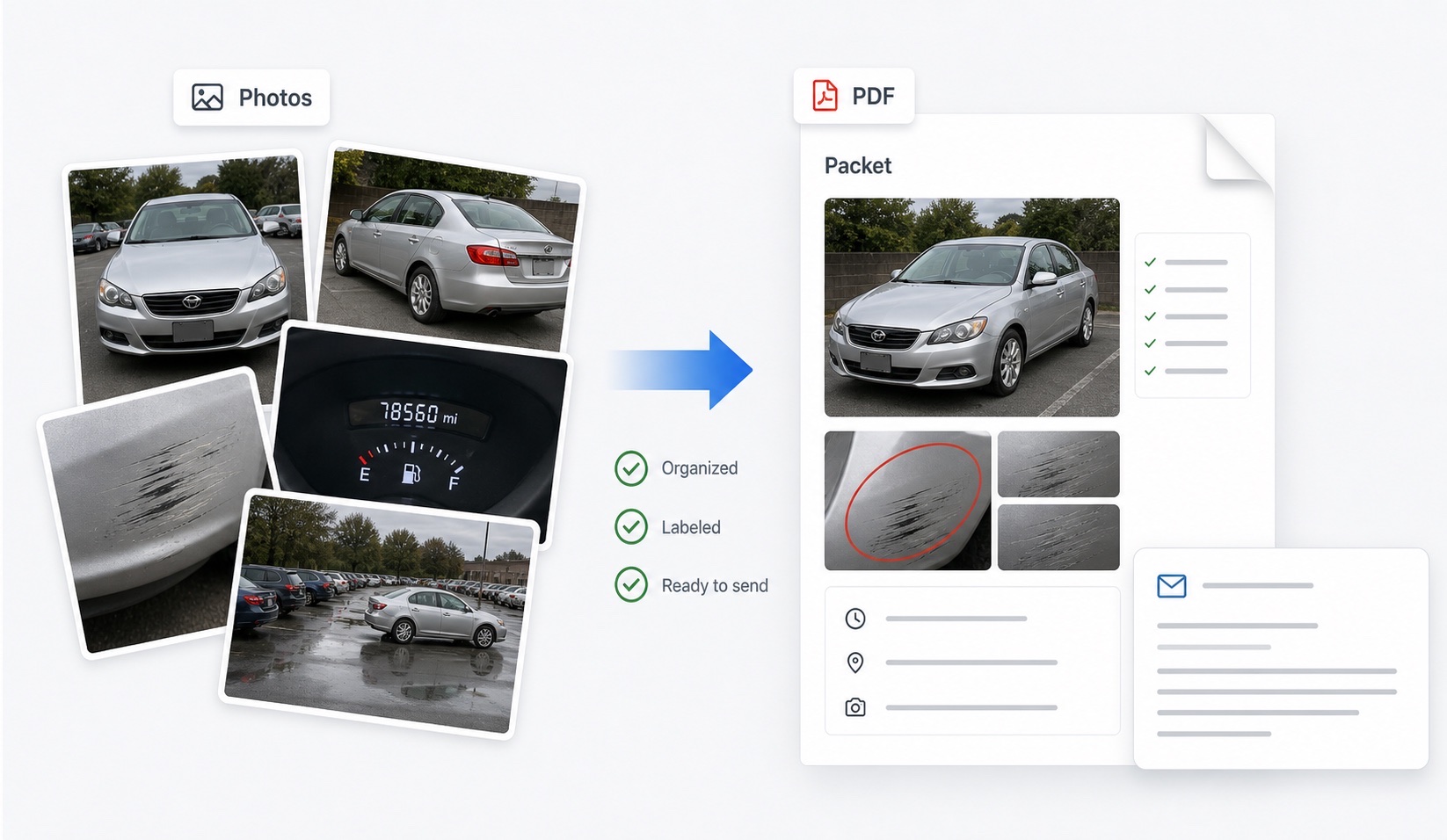
Consolidate the photos into one labeled before-and-after document rather than a folder of image files — a PDF packet with captions per photo, which is the format DamagePacket exports, or a carefully built equivalent. If an enclosure does not exist (no pickup photos, say), renumber honestly and address the gap in one line; the partial-evidence guide covers that situation.
Where and how should I send it?
Delivery is part of the evidence. Steps:
- Send first through the channel on the damage notice — claims email or web portal — so the dispute enters the company's system under your claim number.
- Keep dated proof of sending: the sent email, a portal confirmation screenshot, or certified-mail tracking for physical letters.
- If a physical address is offered for claims correspondence, a mailed copy with tracking adds weight at escalation, though it is rarely necessary in round one.
- Calendar the deadline you set, plus a few days.
- On expiry, follow up on the same thread citing the original date and restating the requests in two lines.
- Preserve everything — the correspondence trail is what supervisors, card administrators, and small claims judges actually read.
One channel done properly beats three channels done loosely; duplicate submissions can spawn duplicate case numbers that fragment your record.
How does the letter change at escalation?
The bones stay identical; three things are added. A history block after the reference line: “This claim was disputed on [date] and followed up on [date]; the documentation requested has not been provided” — attaching the earlier letters. A recipient upgrade: corporate customer relations or the executive office rather than the claims inbox, and, where relevant, a copy to your card benefit administrator or insurer. And a consequences line, stated as fact rather than threat: “If this cannot be resolved, I intend to file complaints with [state attorney general / consumer protection agency] and to pursue the matter in small claims court.” By that round, the sentence is credible precisely because the record shows you did everything else first.
Keep even the escalation letter to a page. The accumulated attachments — original dispute, follow-ups, their non-responses — now argue louder than any added rhetoric could.
FAQ
What should a rental car damage dispute letter include?
Six blocks: your identifiers (agreement, claim, and invoice numbers), the exact charge disputed, a short factual timeline, a numbered list of enclosed evidence, specific documentation requests directed at the company, and one concrete requested outcome with a response deadline.
Is a formal letter better than an email?
Use the channel the damage notice specifies so the dispute enters their claims system, which is usually email or a web form. The formal letter format earns its keep at escalation — supervisor review, corporate offices, consumer agencies — and as the record you would bring to small claims.
Should the letter threaten legal action?
Not in the first round. Early threats route you to defensive scripts and add nothing checkable. State facts, request documents, set a deadline. Escalation language belongs in later correspondence, after the record shows your reasonable requests went unanswered.
How long should the dispute letter be?
One page. The letter is a cover document for the evidence packet; every paragraph beyond the six essential blocks weakens it. Reviewers act on letters they can process in ninety seconds.
What do I do with the letter if the company never responds?
The unanswered letter becomes evidence itself. Send a follow-up citing it, then escalate with copies attached: corporate customer relations, your card benefit administrator if coverage applies, state attorney general or consumer protection complaints, and small claims court if the amount justifies it.