
Credit Card Rental Car Damage Claim: Photo Evidence Checklist
What photo evidence and documents credit card benefit administrators ask for in rental car damage claims, how deadlines work, and how to assemble a packet that gets processed instead of bounced back.
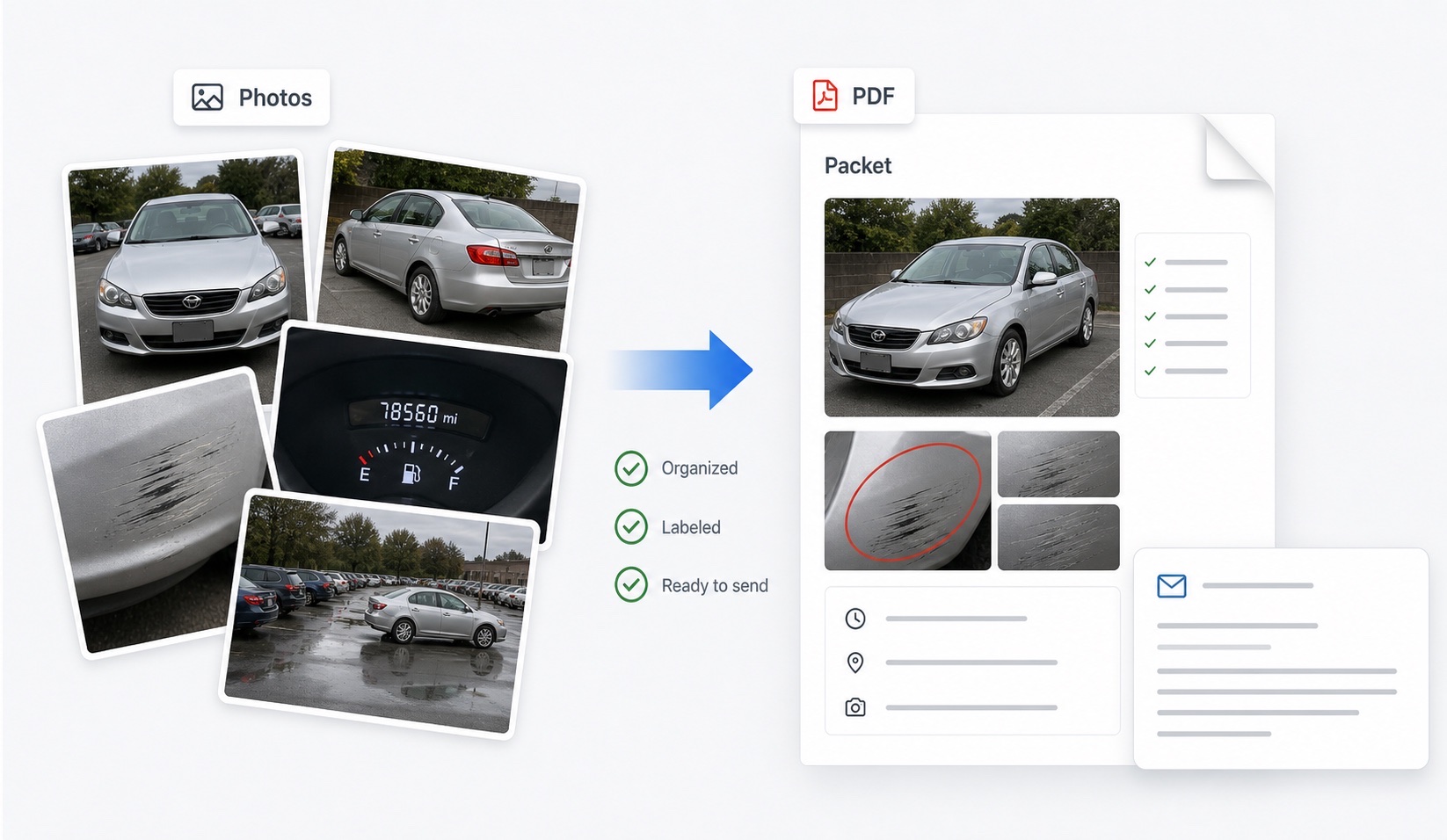
What does a credit card rental damage claim require?
When a rental company bills you for damage and you paid with a card that carries rental collision coverage, the claim goes to the card's benefit administrator — a claims processor working for the card network or issuer, not the bank's regular customer service. Administrators work from document checklists, and incomplete files stall. A typical request list looks like this:
| Document | Purpose |
|---|---|
| Rental agreement (all pages) | Proves dates, renter, and that the waiver was declined |
| Card statement with the rental charge | Proves the covered card paid for the rental |
| Damage notice / demand letter | Defines what the rental company is claiming |
| Itemized repair invoice or estimate | Supports the amount demanded |
| Photos of the damage | Confirms location and extent of damage |
| Police or incident report (if any) | Documents accidents, theft, or vandalism |
Ask the rental company for whatever you lack — administrators expect you to obtain the repair invoice and inspection documents from them.
What photos should be in the claim file?
Send a small, labeled set rather than your whole camera roll. The administrator needs to see the vehicle overall, the claimed damage clearly, and enough context to connect them: full-vehicle shots from pickup and return if you have them, a wide shot of the damaged panel showing where it sits on the car, and close-ups of the damage itself. If the rental company supplied its own photos, include those too, labeled as theirs — the reviewer should see the same evidence set you are responding to.
Label each image with date and vehicle area, and keep unedited originals in case metadata is requested. A packet that presents ten labeled photos in pickup/return pairs is dramatically easier to process than forty unlabeled uploads; this is the organizing step DamagePacket automates, though a careful manual folder achieves the same thing.
How do the deadlines work?
Card benefit programs run on two clocks. The first is the notice deadline: many benefit guides require you to report the incident to the administrator quickly — commonly within roughly 30 to 45 days of the damage or the demand, depending on the program. Missing it can forfeit the benefit entirely, so open the claim as soon as a damage notice arrives, even while you are still disputing the charge with the rental company. The second clock is the documentation deadline: once the claim is open, administrators typically allow a longer window, often measured in months, to submit the full file.
Because programs differ, pull your card's current guide to benefits — usually a PDF available from the issuer — and confirm both windows in writing. When in doubt, notify first and gather documents second.
Is my card coverage primary or secondary?
Most rental collision benefits in the U.S. are secondary, meaning they pay after your personal auto insurance, and the administrator may ask what your insurer covered before reimbursing the rest, including your deductible. Some premium cards offer primary rental coverage, which pays without involving your auto policy — a meaningful difference, because a claim on your own insurance can affect premiums. Your guide to benefits states which type you have.
Almost all programs share one non-negotiable condition: you must have declined the rental company's collision damage waiver (CDW/LDW) at the counter and paid for the rental with the covered card. Coverage also typically excludes certain vehicle classes, some countries, and rentals beyond a stated length. Verify these before relying on the benefit — and see the full filing walkthrough for the step-by-step process.
How should I present weak spots in my evidence?
Call them out yourself. If you have no pickup photos, say so and lean on what you do have: return photos, receipts, and the rental company's own inspection records (the no-before-photos guide covers this scenario). If a photo is blurry or a panel was never shot, note it. Administrators review files professionally, and an honest gap acknowledged in one line does far less harm than an overstated claim they later discover.
The same honesty applies to fees. If the rental company's demand includes loss-of-use or administrative fees, list them separately in your cover note and state whether supporting documentation, such as a fleet utilization log, was provided — many benefit programs condition reimbursement of those fees on exactly that paperwork. Keep the cover note under a page: claim number, what is attached, what is missing, and what you are asking the administrator to do.
FAQ
What documents do credit card rental car damage claims ask for?
Benefit administrators commonly request the rental agreement, the card statement showing the rental was paid with the covered card, the damage notice or demand letter, an itemized repair invoice or estimate, photos of the damage, a police report if one exists, and any accident or incident report.
Do I need photos for a credit card rental damage claim?
Photos are usually requested when available, and they strengthen the file even when optional. Pickup and return photos help the administrator confirm what damage is claimed, where it is, and whether the rental company's demand matches visible condition.
How long do I have to notify the card benefit administrator?
Deadlines vary by card. Many benefit guides require notice of the incident promptly, often within roughly 30 to 45 days, with full documentation due later. Check your specific guide to benefits and open the claim early even if you are still gathering documents.
Does credit card rental coverage pay for everything the rental company demands?
Not necessarily. Coverage typically applies to damage to or theft of the rental vehicle itself, and reimbursement of loss-of-use or administrative fees often depends on documentation such as a fleet utilization log. Liability for injury or damage to other property is generally excluded.
Is DamagePacket an insurance claim service?
No. DamagePacket organizes your photos and documents into a readable evidence packet you can attach to a claim. It does not decide coverage, negotiate with administrators, or provide insurance advice.