
Rental Car Return Photo Checklist for Airport or After-Hours Drop-Off
The specific photo routine for airport return lanes, night drops, and unattended lots — where nobody confirms the car's condition and your photos become the only record of the handoff.
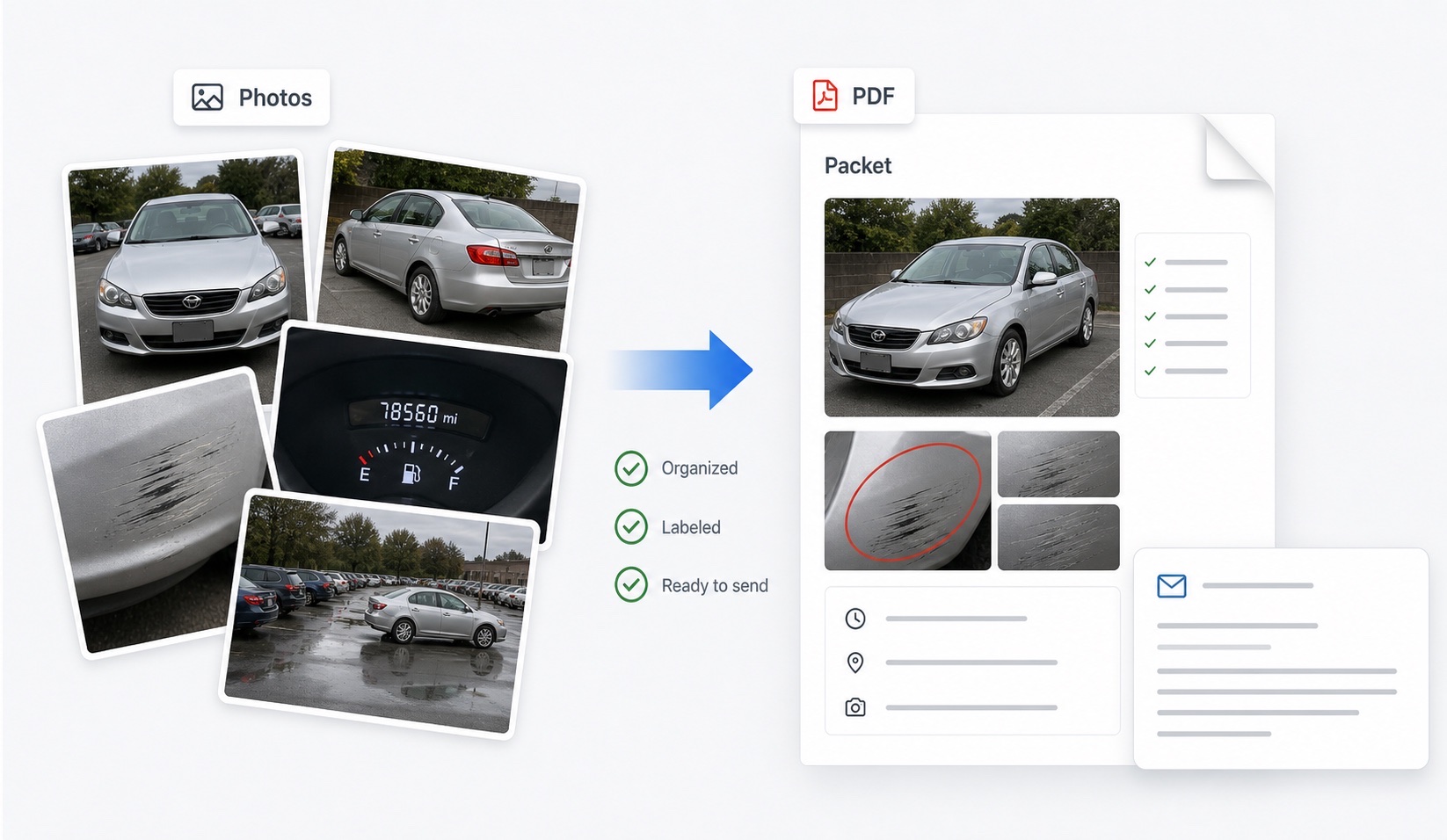
Why do unattended returns generate so many claims?
Because the handoff, legally the moment your responsibility ends, happens with no witness on the company's side. At a staffed return, an attendant walks the car, notes condition, and hands you a receipt — a contemporaneous record from their own employee. At an airport night drop, you park in a lane, lock the keys in a box, and leave; the first documented look at the car may come hours later at cleaning, or days later at the next checkout. A door ding from the adjacent stall, a cart strike, a scrape from the employee who shuttles it to the wash — all of it lands in the window your rental agreement still covers unless you can show the car's condition when you walked away.
That is the entire logic of the after-hours routine: you are creating the inspection record the company will not.
What is the complete after-hours photo checklist?
Ten minutes, done in this order before the keys go in the drop:
| # | Shot | Notes |
|---|---|---|
| 1 | Front, rear, both sides | Full car in frame, plate visible in at least one |
| 2 | Four corners at 45° | Where lane scrapes and bumper scuffs hide |
| 3 | All four wheels | Curb rash is a frequent late claim |
| 4 | Windshield and glass | Angle the shot to catch chips in the light |
| 5 | Roof | Arm extended or from a curb; often skipped, sometimes claimed |
| 6 | Interior + cargo area | Seats, dash, trunk empty |
| 7 | Odometer and fuel gauge | Ignition on so the cluster reads |
| 8 | Stall number and return lane signage | Places the car at the return facility |
| 9 | Key drop box | With keys in hand, then deposited if practical |
| 10 | Receipt or app confirmation screen | Screenshot immediately — this is your timestamp |
How do I make night photos actually usable?
Dark garages and floodlit lanes defeat casual photography, and a blurry return set is barely better than none. The technique: turn on flash for panel shots and take each one twice — once with flash, once braced and steady without, since flash can white-out the exact scratch you need while ambient light shows it. Brace against a pillar or hold elbows to ribs for anything slower than daylight. Prefer wider framing; night close-ups blur and lose context simultaneously. For dark lower panels and wheels, crouch so the phone is level with the surface rather than angled down into shadow.
Then — the step everyone skips — review the photos before leaving the lane. Zoom into two or three at random. Thirty seconds of checking catches the smeared lens or focus-hunt that would otherwise surface only when a claim arrives, when the lot and the moment are unrecoverable.
What proves when I returned the car?
Condition photos without a fixed time are half an argument; the after-hours routine deliberately stacks timestamps. Your photo metadata carries capture time and usually GPS — keep originals unedited. The app return confirmation or emailed receipt fixes the contractual end of the rental; screenshot it on the spot in case it is later revised or delayed. Around those anchors, incidental records corroborate: the airport shuttle or terminal timestamp, a toll or fuel purchase minutes before arrival, the boarding pass for the flight you walked to. Independently, each is minor; together they make “the car left my custody at 22:41 in stall 14” a documented fact rather than a recollection.
If the drop-box area has posted instructions or a camera notice, photograph that too — it identifies procedures and potential footage worth requesting if a dispute develops.
What do I do with the photos if a claim arrives later?
The set earns its keep weeks later, when a notice claims damage you know nothing about. The response sequence: match the claimed panel against your numbered return set; pair each return shot with its pickup counterpart if you took one; lead your written dispute with the timeline — documented return time versus the company's damage-discovery date — and request their inspection report, dated photos, itemized invoice, and the vehicle's rental history since your drop-off. The after-return dispute guide walks the full process, and the email template gives it a format.
Presentation-wise, convert the raw set into a labeled before-and-after packet — captions with date, panel, and stall — either manually or with a tool like DamagePacket, and keep originals untouched. An unattended return documented this way is often stronger evidence than a staffed one, because you controlled the record and it is complete.
FAQ
What should I photograph at an after-hours rental car return?
The complete exterior (eight angles), wheels, glass, roof, interior, odometer, and fuel level — plus context: the stall number, return lane signage, the key drop, and your final receipt or app confirmation screen. The context shots tie the condition photos to the time and place of return.
Why are airport returns riskier for damage claims?
Volume and gaps. Cars queue in tight lanes, get shuttled by staff after you leave, and may not be formally inspected for hours or days. Any damage in that window can be attributed to your rental unless your photos establish the condition at hand-back.
How do I take usable photos in a dark return garage?
Use flash, brace the phone or your elbows, and prefer wider, steadier shots over close-ups that blur. Take several frames of each dark panel and check them before leaving — a slower walkaround with verified shots beats a fast one you discover is unusable at the gate.
Does the app return confirmation protect me?
It fixes the time your rental ended, which anchors your timeline — but it says nothing about condition. Screenshot it immediately and pair it with the photo set; the timestamp plus matched photos is what makes a later claim contestable.
What if damage is claimed weeks after an unattended return?
Your return set becomes the core evidence. Respond with the timestamped photos, the receipt or app confirmation, and a request for the company's inspection date and the vehicle's rental history since your drop-off — the after-return dispute guide covers the full process.