
Vehicle Damage Report Template: What to Include
The sections every vehicle damage report needs — vehicle details, photo inventory, observations, documentation requests, and next steps — with a copyable skeleton and guidance on writing observations that hold up.
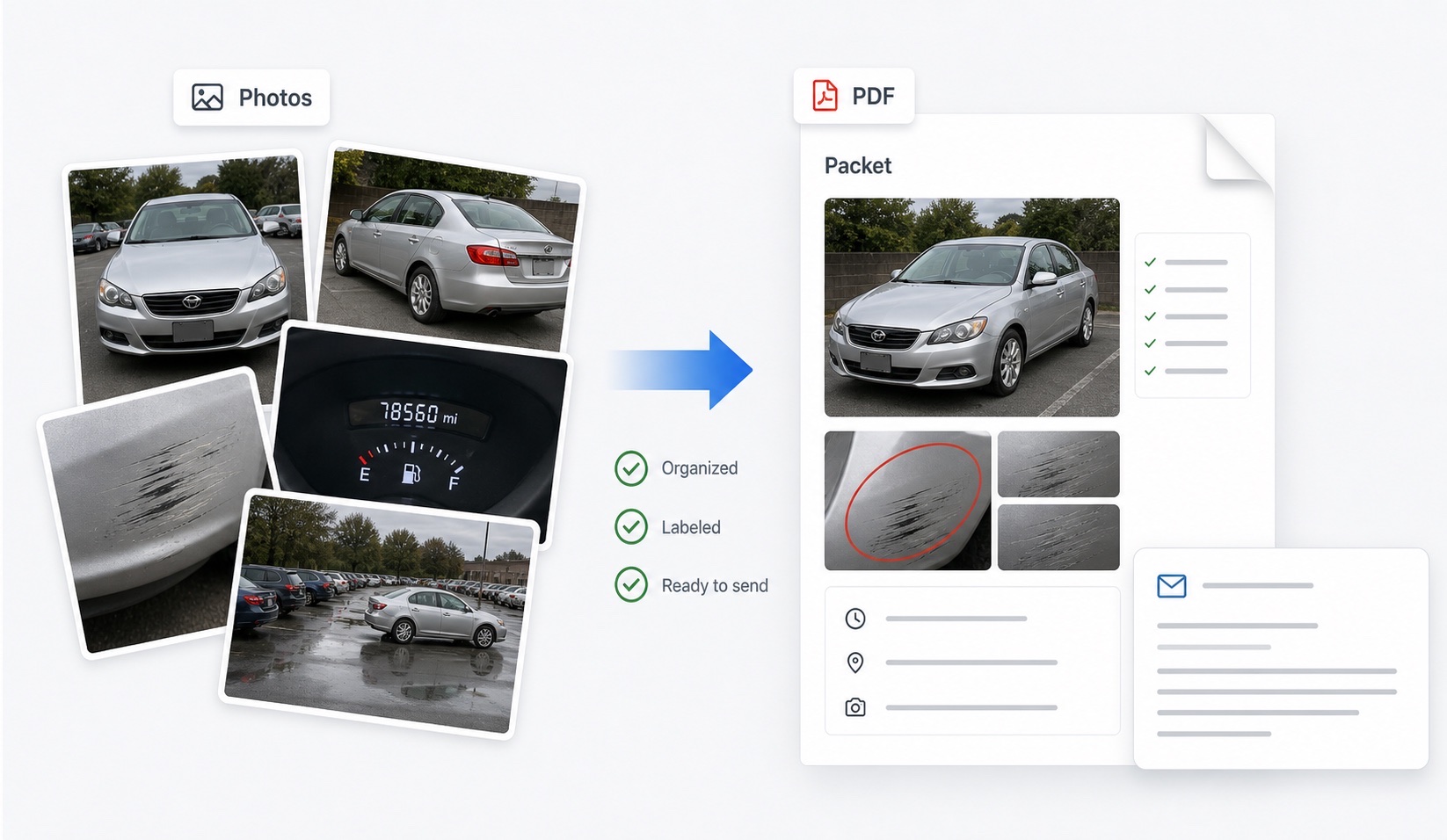
What sections does a vehicle damage report need?
A damage report is a structured summary that lets a stranger reconstruct the situation from documents alone. Whatever the dispute — rental charge, insurance claim, valet incident, fleet handoff — the same seven sections do the work:
| Section | Contents |
|---|---|
| 1. Vehicle details | Make, model, color, plate or VIN if available |
| 2. Context | Dates, location, parties, why the report exists |
| 3. Photo inventory | Every image, numbered, with date and vehicle area |
| 4. Observations | Visible condition by area, before vs. after |
| 5. Supporting notes | Receipts, messages, and honest evidence gaps |
| 6. Documentation requests | What the other party should produce |
| 7. Next steps | The specific outcome being requested |
Order matters: facts before comparisons, comparisons before requests. A reviewer who has to hunt for the vehicle details in paragraph four has already discounted the report.
How do I build the photo inventory?
The inventory is the section that turns a camera roll into evidence. List every photo you are submitting, numbered, each with three fields: date taken, vehicle area, and a one-line description of what is visible. Group them by timeline — all “before” photos first, then all “after” photos in the same panel order — so matched angles sit in predictable positions. If photos came from different sources (your phone, the rental company, a valet's incident report), label the source of each.
Two disciplines make the inventory trustworthy. First, keep original files untouched and note that unedited originals with metadata are available on request. Second, do not curate away inconvenient images; if a photo shows pre-existing damage on your side of the ledger, include and label it. An inventory that reads as complete is worth more than one that reads as favorable.
How should observations be written?
Observations are where most reports go wrong, because writers slide from describing to arguing. The fix is a strict formula: area, location, size, type. “Rear bumper, driver side corner, approximately 4 cm scuff, paint transfer visible” is an observation. “Damage clearly caused by the valet” is a conclusion, and it belongs — if anywhere — in a clearly labeled account section, not among the observations. When you have before and after photos of the same panel, write the comparison neutrally: what the before photo shows, what the after photo shows, and whether the mark appears in both.
Uncertainty gets stated, not smoothed over: “lighting in photo 12 makes the panel difficult to assess” costs you nothing and buys credibility. Reports written this way survive hostile reading, which is the only kind of reading a disputed report gets.
What documentation should the report request?
A damage report is also a demand for the other side's evidence, and listing requests explicitly puts the burden where it belongs. Depending on the dispute, reasonable requests include: dated photos supporting the claim against you, the inspection or incident report and who performed it, an itemized repair invoice or estimate rather than a flat figure, timestamps establishing when the damage was found, the vehicle's rental or usage history between your handoff and the inspection, and for rental claims with add-on charges, the calculation behind any loss-of-use or administrative fees.
Phrase each as a request, not an accusation: “please provide the return inspection report and the date it was completed.” If the other party cannot produce basic documentation, that fact itself becomes part of your next reply.
Is there a skeleton I can copy?
Yes — the following outline works as a plain document or email attachment:
- Report title and date — “Vehicle Damage Report — [vehicle] — [date]”.
- Vehicle — make, model, color, plate/VIN, agreement or claim number.
- Context — two to four sentences: who had the vehicle, when, where, and what claim or charge prompted the report.
- Photo inventory — numbered list: date, area, description, source.
- Observations by area — front, rear, driver side, passenger side, wheels, glass, roof, interior; before/after comparison for each disputed area.
- Supporting notes — receipts, messages, evidence gaps.
- Documentation requests — the list from the section above.
- Requested outcome — one specific ask with a response window.
DamagePacket generates this structure automatically from uploaded photos and exports it as a PDF, but the skeleton above is the substance either way.
FAQ
What belongs in a vehicle damage report?
Seven sections: vehicle identification, incident or handoff context, a photo inventory listing every image with date and area, visible-condition observations grouped by vehicle area, supporting notes including honest evidence gaps, documentation requests directed at the other party, and requested next steps.
Is a template enough, or do I need a tool?
A template is enough if you fill it carefully and label your photos. The work is in the middle: inventorying images, matching before and after angles, and writing neutral observations. Tools like DamagePacket automate that assembly, but the structure matters more than how you produce it.
How should I describe damage in the report?
Describe what is visible, not what you conclude: panel, location on the panel, approximate size, and type of mark (scratch, dent, scuff, crack). Avoid causation language like 'from the accident' unless you are labeling it explicitly as your account rather than an observation.
Should the report mention photos I failed to take?
Yes. A one-line note such as 'no roof photo was taken at pickup' preserves credibility. Reviewers notice gaps anyway; a report that flags its own limits reads as honest, and honesty is the currency disputes trade in.
Who is the audience for a vehicle damage report?
Whoever decides your dispute: a rental company claims agent, an insurance adjuster, a credit card benefit administrator, a marketplace claims reviewer, or a small claims judge. Write for a busy stranger seeing the situation for the first time.