
What Information to Include in a Car Insurance Claim
A checklist of the facts, photos, documents, and communication records to organize before filing a car insurance claim, plus the claim timeline and the missteps that slow claims down.
What information does a car insurance claim need?
Insurers process claims fastest when the first notice arrives complete. Before you call or open the app, assemble this set:
| Category | Details to gather |
|---|---|
| Policy | Policy number, named insured, insurer claims phone/app |
| Incident basics | Date, time, exact location, weather and road conditions |
| Vehicles and people | All vehicles (make, model, plate), drivers, passengers, injuries if any |
| Other parties | Names, contact details, insurance carrier and policy numbers, witness contacts |
| Official records | Police report number and agency, citations issued |
| Damage evidence | Photos of all vehicles and the scene, dashcam footage |
| Costs so far | Towing, storage, rental receipts |
Missing items should not delay the first report — note them as pending and supply them as they arrive. What matters is that nothing you already have gets lost between the incident and the file.
How should I describe what happened?
Write a short factual narrative before you speak to anyone, while details are fresh: direction of travel, what each vehicle did, point of impact, what happened immediately after. Stick to observations — “the other car entered the intersection as the light turned” — and avoid three categories of statement. First, fault conclusions in either direction: “it was my fault” and “they were clearly reckless” are both determinations the insurers will make from evidence. Second, precise guesses you cannot support: estimated speeds, distances in feet, seconds elapsed. Third, health declarations like “I'm fine” — some injuries surface later, and the record should stay open.
Use the same narrative every time you retell the event — to your insurer, the other insurer, or an adjuster. Inconsistency between retellings, even innocent, is what claim reviewers probe hardest.
How do I organize photos for the claim?
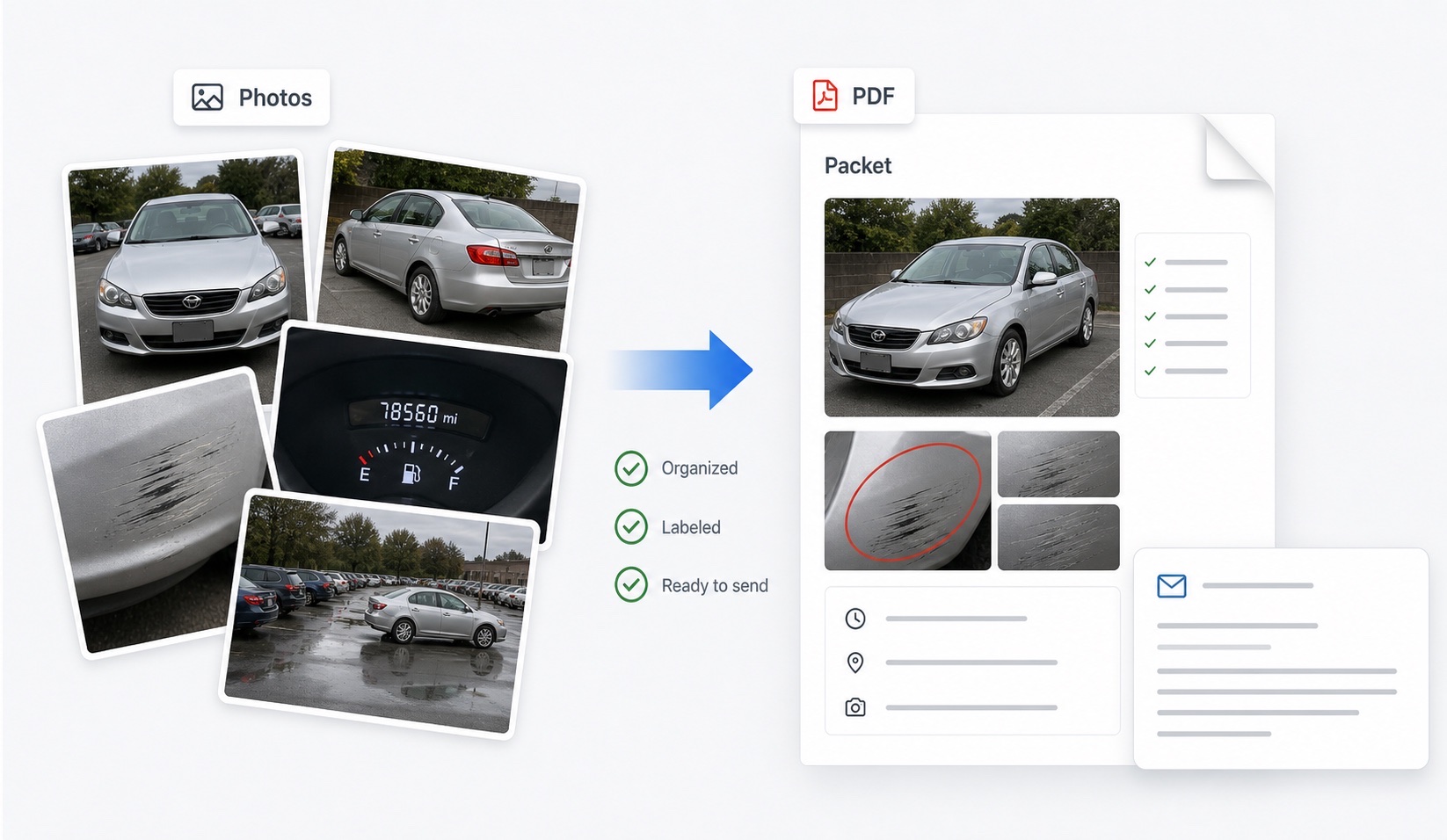
Group photos so an adjuster can navigate them without you on the phone: scene photos first (positions of vehicles, skid marks, signage, sightlines), then each vehicle in a wide-to-close sequence — full car, affected panels, close-up damage — and finally supporting shots such as the odometer, VIN plate if requested, and any deployed airbags or interior damage. If you have pre-incident photos of your car, include them; they answer the pre-existing-damage question before it is asked.
Label everything by date and subject, keep unedited originals with metadata, and submit a curated set rather than the full camera roll. The adjuster photo guide covers the specific angles reviewers look for; a labeled packet — assembled manually or with a tool like DamagePacket — keeps the whole set readable.
What does the claim process look like after filing?
The broad sequence is consistent across insurers, even though timelines vary by state and policy:
- First notice of loss — you report the incident by phone, app, or online form and receive a claim number.
- Assignment — an adjuster or claims handler takes the file and contacts you, usually within days.
- Investigation — the adjuster reviews photos, statements, the police report, and may inspect the vehicle in person or from images.
- Estimate and coverage decision — the insurer determines what the policy covers and the repair value, applying your deductible.
- Repair or payout — repairs proceed at a shop of your or the insurer's arrangement, or a total-loss settlement is offered.
- Supplements — if the shop finds hidden damage mid-repair, a supplemental claim adjusts the estimate.
Keep your claim number on every message, and log each call with date, name, and substance.
What slows claims down or hurts them?
The avoidable delays cluster into a few patterns. Waiting weeks to report gives the insurer a notice argument and lets evidence evaporate. Authorizing full repairs before inspection removes the insurer's chance to assess damage and can jeopardize reimbursement — do reasonable temporary mitigation (a tarp, a tow off the street) but hold permanent work. Discarding damaged parts or releasing the car from storage without photos destroys evidence the adjuster may need. Gaps in the paper trail — missing tow receipts, unlogged calls, the other driver's details on a scrap of paper you lost — each cost a round-trip of correspondence.
And the recordkeeping habit that prevents most of it: one folder, physical or digital, holding the claim number, every photo, every receipt, every letter and email, from day one. Insurance claims are document contests; the organized file wins the schedule, and sometimes the outcome.
FAQ
What information should I collect before filing a car insurance claim?
Your policy number and insurer contact, the date, time, and location of the incident, all vehicles and drivers involved with license and insurance details, a plain factual description of what happened, photos of damage and the scene, a police report number if one exists, and receipts for towing or related costs.
How soon should I report a claim to my insurer?
Promptly — most policies require timely notice, and many insurers let you open a claim the same day by app or phone. You can open the claim first and supply photos, estimates, and reports as they become available.
Should I admit fault when filing the claim?
Describe what happened factually and let the insurer determine fault. Avoid speculating about blame in either direction — statements guessing at fault, speed, or distances can complicate the claim, especially when another party's insurer is involved.
Do I need repair estimates before filing?
No. Most insurers assign an adjuster or direct you to approved shops after the claim is opened. Do not authorize permanent repairs before the insurer has inspected or approved, unless the policy says otherwise; reasonable temporary measures to prevent further damage are generally fine.
Is DamagePacket an insurance adjuster or claims service?
No. DamagePacket organizes vehicle photos into a labeled evidence packet you can attach to a claim. It does not assess fault, estimate repair costs, or decide coverage — those remain the insurer's decisions.