
Enterprise Damage Recovery Unit: How to Dispute a Claim
What the Enterprise Damage Recovery Unit is, why its letters arrive weeks after your rental, how loss-of-use and administrative fees are built, and the written response that puts the burden of proof back on the claim.
What is the Damage Recovery Unit and how does it work?
Enterprise Holdings — the parent of Enterprise, National, and Alamo — centralizes damage claims in a dedicated operation, the Damage Recovery Unit. When a branch attributes damage to your rental, the file moves to the DRU, which sends the letter, sets the amount, and handles the correspondence. Two consequences follow. First, arguing with the branch is largely pointless once the DRU holds the file; your written response goes to the claims contact on the letter, quoting the claim number. Second, the DRU is a volume operation processing files — which means it responds to documents, deadlines, and substantiation requests far more than to phone-call frustration.
The letter typically includes a damage description, an amount or a pending appraisal, and a response window. Treat the window seriously, respond in writing, and start assembling your rental record the day it arrives.
Why do Enterprise claims so often surface late?
Enterprise's network is heavy on neighborhood branches with tight lots and fast turnarounds. Cars are returned, cleaned, and re-rented quickly; condition may not be formally documented at your drop-off at all, particularly at busy locations or after-hours returns. Damage then gets recorded at cleaning, at the next customer's checkout, or during a periodic inspection — and attributed backward to the most recent rental on file, which may be yours. Consumer-advocacy reporting on Enterprise claims has repeatedly turned on exactly this gap: damage “discovered” days after return, sometimes after intervening rentals.
That makes the two-timestamp question your central demand: when, precisely, was the damage first documented, and what happened to the vehicle between your documented return and that moment? If the answer includes another rental, the attribution to you is an assumption, and you should say so — neutrally, in writing.
How are the DRU invoice amounts built?
DRU invoices are itemized, and each line has its own logic to test:
| Line | Basis | What to ask |
|---|---|---|
| Repair / appraisal | Body shop invoice or appraisal service estimate | Itemized invoice; was the repair actually performed? |
| Loss of use | Daily rate for days the car was out of service — commonly derived from repair labor hours | How were the days calculated? Does fleet utilization show the car would have been rented? |
| Administrative fee | Flat processing fee, often tiered by repair size | The fee schedule and its basis |
| Diminished value | Claimed resale loss | The appraisal method — skeptically, for cosmetic repairs |
State law matters here: several states regulate what rental companies may recover from renters for loss of use, and card benefit programs commonly reimburse it only against a fleet utilization log — both facts that make “please substantiate this line” a reasonable, answerable request. The loss-of-use guide expands on each challenge.
What should my response to the DRU contain?
- Reference block: claim number, rental agreement number, branch, rental dates.
- Dispute statement: one sentence contesting the charge (or specific lines of it).
- Timeline: pickup, return with receipt or closed-contract time, letter arrival — dated lines, no narrative.
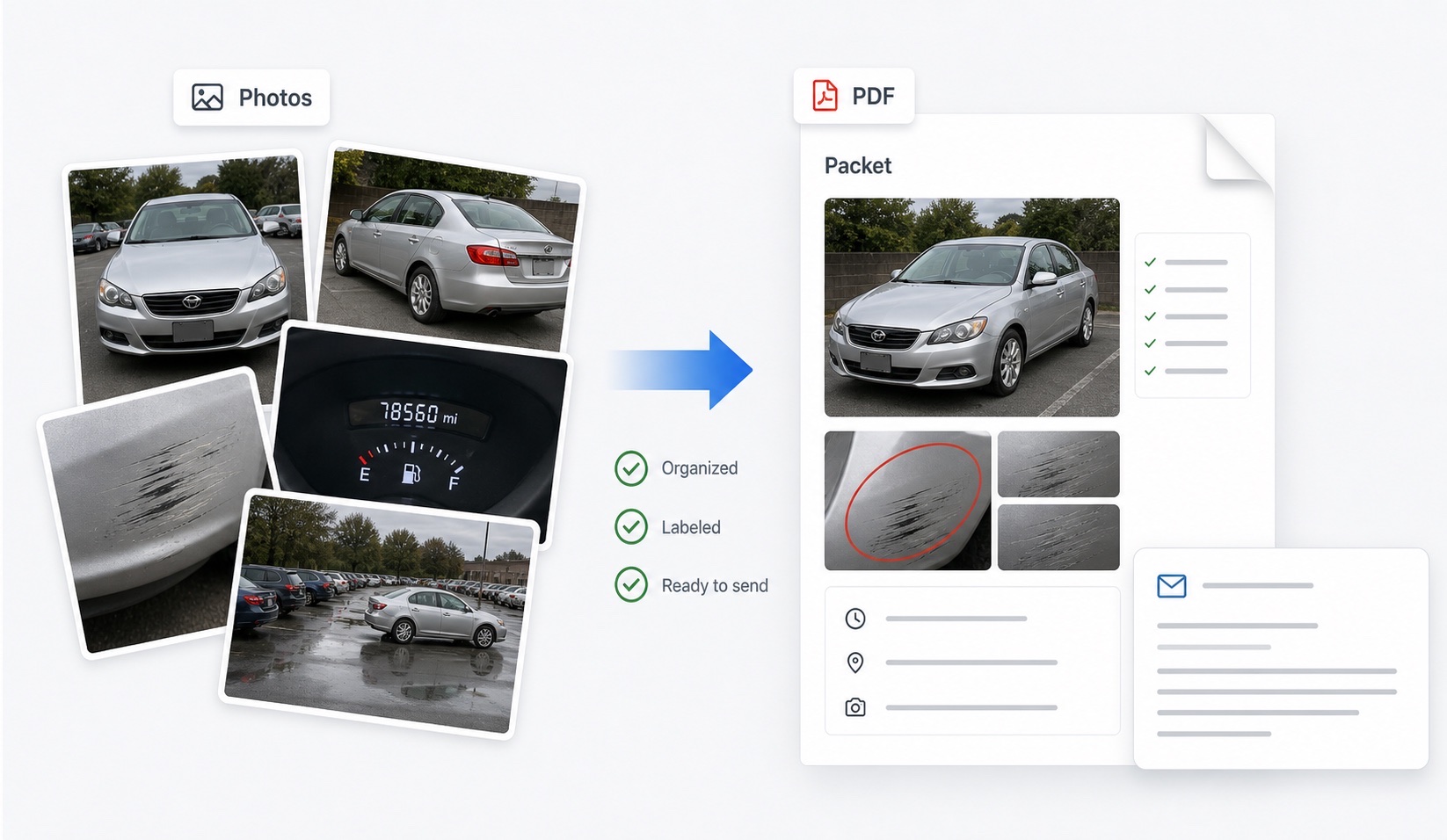
- Evidence: your labeled pickup/return photo packet, the agreement and checkout report, the return receipt. A packet with matched panels and captions — DamagePacket's output, or a careful manual equivalent — reads in minutes.
- Requests: the inspection report and its date; dated damage photos; the itemized repair invoice; the vehicle's rental history since your return; the loss-of-use calculation and utilization support; the administrative fee schedule.
- Ask and window: withdraw or substantiate within 10 business days.
Send it through the channel on the letter, keep dated copies, and log every exchange — the letter template supplies full wording.
What if the DRU holds the claim open anyway?
DRU files can stay open for months, with periodic re-sent invoices. Persistence with a paper trail is the counter. Re-respond to each demand by referencing your dispute date and the still-unproduced documents — never let a demand go unanswered, since silence is what precedes collections. In parallel, run your coverage tracks: the card benefit claim if you declined the waiver (the administrator's own document requests to Enterprise often shake loose the substantiation you asked for), and your insurer where applicable. If collections contact begins despite an active documented dispute, you can dispute the debt's validity with the collector in writing and add that correspondence to the file.
External pressure remains available — state attorney general complaints, consumer-advocacy organizations that maintain Enterprise escalation contacts, small claims where money was already taken. Most disputed DRU claims end quietly: reduced to the documented repair, or closed without explanation once the file shows a renter who asked precise questions and kept every answer.
FAQ
What is the Enterprise Damage Recovery Unit?
The Damage Recovery Unit (DRU) is the centralized claims operation that pursues vehicle damage claims for Enterprise and its sister brands National and Alamo. If you receive a DRU letter, the claim has left the rental branch — your dispute needs to go to the DRU in writing, referencing the claim number.
Why did the DRU letter arrive weeks after my Enterprise rental?
Damage may be recorded at cleaning, at a later checkout, or during branch inspections, and claims processing adds more time. The delay is a legitimate line of attack: ask in writing when the damage was first documented and whether the car was rented to other customers between your return and that date.
What fees does an Enterprise damage claim include?
DRU invoices commonly itemize the repair or appraisal amount plus loss-of-use for the days the car was allegedly out of service, an administrative fee, and sometimes diminished value. Each line can be separately questioned; ask how loss-of-use days were calculated and whether fleet utilization supports them.
Can I ignore a Damage Recovery Unit letter?
Ignoring it is risky — unanswered claims can be sent to collections. Respond in writing within the stated window: dispute the charge, attach your evidence, and request the inspection report, dated photos, itemized repair invoice, and rental history. A documented dispute changes the file's posture even if it takes months to resolve.
Does my credit card cover an Enterprise DRU claim?
Possibly — if you declined Enterprise's damage waiver and paid with a card carrying rental collision coverage. Open the benefit claim quickly, since notice windows are short, and note that administrators often require Enterprise's own documentation (repair invoice, fleet utilization log for loss-of-use) before reimbursing.