Vehicle damage report.
Create a vehicle damage report for rental, fleet, valet, car wash, transport, insurance, or peer-to-peer handoffs — photo inventory, visible observations by area, documentation requests, and PDF export.
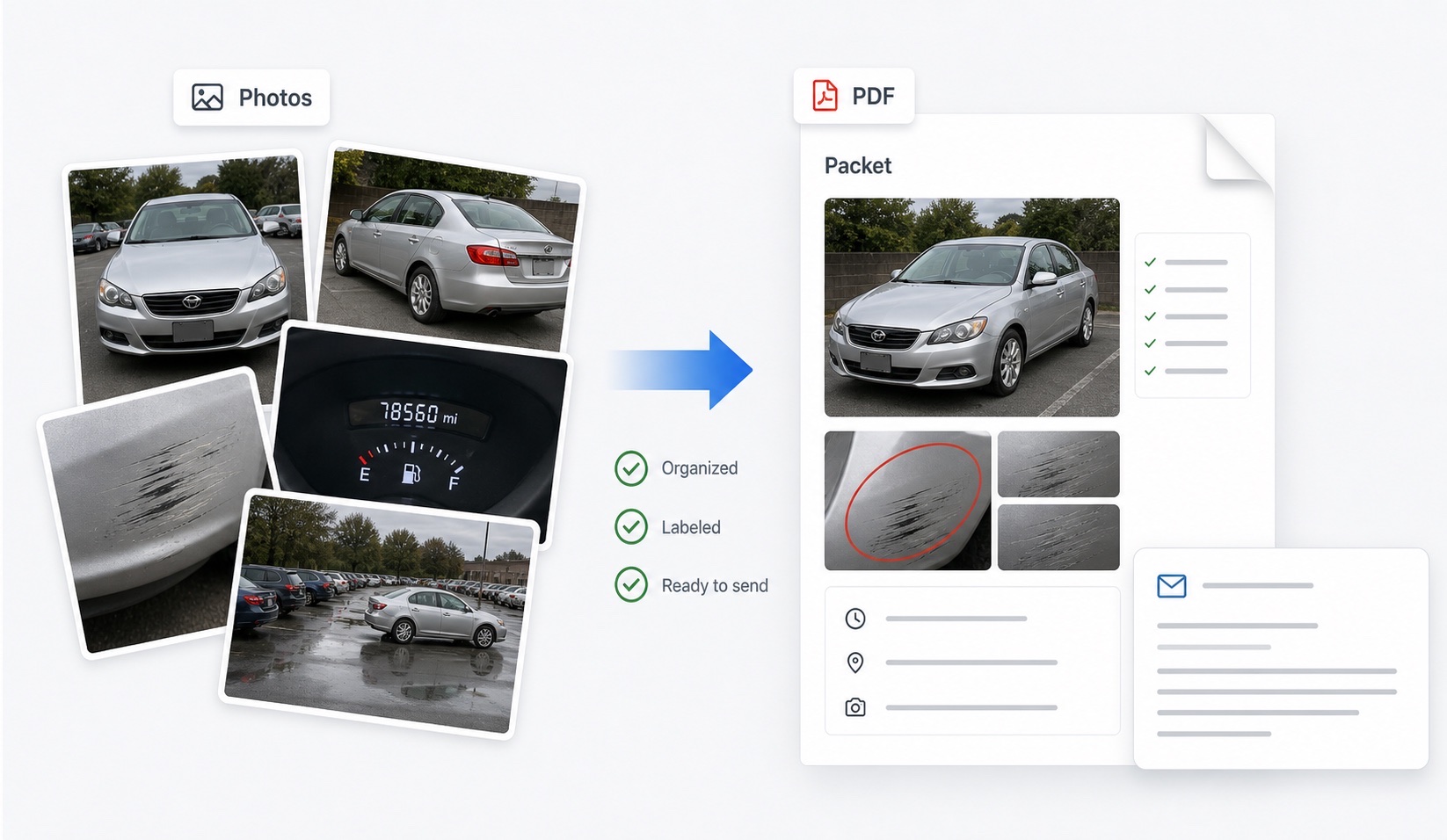
What is a vehicle damage report and when do you need one?
A vehicle damage report is the document version of “here is exactly what the vehicle looked like, and when.” It records identification (vehicle, dates, parties), inventories the photo evidence with labels, states visible observations area by area, compares before and after where both exist, and lists what documentation the other side should produce. You need one whenever vehicle condition is about to be argued about by people who were not standing at the car together: a rental company claiming post-return damage, a fleet swapping vehicles between drivers, a valet stand facing a scratched door claim, a transport company delivering a car across the country, an insurer reviewing a claim.
The report exists because raw photos, however good, do not carry their own context. A reviewer needs to know which panel, which date, which handoff — and what is deliberately not being claimed. Structure is what turns photographs into evidence.
What sections does the report contain?
DamagePacket generates the standard seven-section structure that claims reviewers expect:
| Section | Contents |
|---|
| Vehicle details | Make, model, color, plate or VIN, agreement/claim numbers |
| Context | Dates, location, parties, why the report exists |
| Photo inventory | Every image numbered, with date, area, and source |
| Observations | Visible condition by vehicle area; before/after comparisons |
| Supporting notes | Receipts, messages, and disclosed evidence gaps |
| Documentation requests | What the other party should produce |
| Requested next steps | The specific outcome and response window |
The template guide walks each section with a copyable skeleton if you prefer to build the document manually — the structure is the substance either way.
How is the report used across different handoffs?
The format flexes across use cases because the underlying question — documented condition at a point in time — is universal. Rental returns: pickup and return sets become the before/after comparison attached to a damage dispute. Fleet and pool vehicles: a report per handoff makes driver-to-driver damage attribution a lookup instead of an argument. Valet and parking: the drop-off set plus the incident report anchors a claim against the operator. Vehicle transport: origin and delivery reports bracket the carrier's custody. Peer-to-peer rentals: trip-start and trip-end packets serve hosts and guests inside marketplace claims. Insurance: the organized photo layer adjusters work from.
In every case the report is attached to the process that decides the outcome — it does not replace that process, it feeds it the evidence in usable form.
How do you produce one in practice?
- Photograph systematically at the handoff or incident: wide-to-close, all panels, wheels, glass, roof, interior, odometer — the photo technique guide covers the method.
- Upload the sets to DamagePacket — before, after, or both — in common phone formats.
- Review the generated inventory and observations, correcting labels and flagging pre-existing damage and gaps so every line is one you can stand behind.
- Add the documentation requests relevant to your situation — inspection reports, invoices, rental history, fee calculations.
- Export the PDF and attach it to the dispute email, claim file, or handoff record; keep original photos untouched.
The habit version for recurring handoffs — fleets, hosts, frequent renters — is one report per handoff, archived. Condition disputes then resolve by opening a file rather than reconstructing a memory.
What are the limits of a vehicle damage report?
Knowing what the report cannot do is part of using it well. It documents visible condition from photographs — it does not prove causation (who or what made the mark), does not price repairs, does not assess fault, and does not bind any company to accept your account. A car wash report shows the antenna intact at entry and broken at exit; whether the wash is liable involves negligence, disclaimers, and state law. A rental report shows a clean bumper at return; whether the charge is withdrawn depends on the company's own records and the dispute you run with them.
That boundary is why every strong report pairs with process: the written dispute, the documentation requests, the coverage claims, the escalation ladder — all covered in the guides library. The report is the evidence layer those processes run on. It is not legal advice, insurance advice, or a repair estimate, and it should never claim more than its photos show.
FAQ
What is a vehicle damage report?
A structured document recording a vehicle's visible condition from photos: identification and context, a labeled photo inventory, observations grouped by vehicle area, before-and-after comparison where both sets exist, supporting notes, and the documentation being requested from the other party.
Can this be used outside rental cars?
Yes. The same format serves fleet handoffs, valet and parking incidents, car wash claims, vehicle transport deliveries, peer-to-peer rentals, and insurance documentation — any situation where a vehicle changes hands or condition is disputed.
Who reads a vehicle damage report?
Claims agents, insurance adjusters, card benefit administrators, marketplace reviewers, fleet managers, and occasionally small claims courts. The report is written for a busy stranger who was not there — which is exactly why structure and neutrality matter.
What makes a report hold up under challenge?
Neutral observations (panel, location, size, mark type) rather than conclusions about fault, full-vehicle coverage rather than damage-only close-ups, matched before/after angles, disclosed evidence gaps, and untouched original photos available on request.
Is the report a substitute for an insurance appraisal?
No. It documents visible condition; it does not price repairs or determine coverage. Appraisals, estimates, and coverage decisions are made by shops, adjusters, and insurers — usually faster when the photo record arrives organized.
